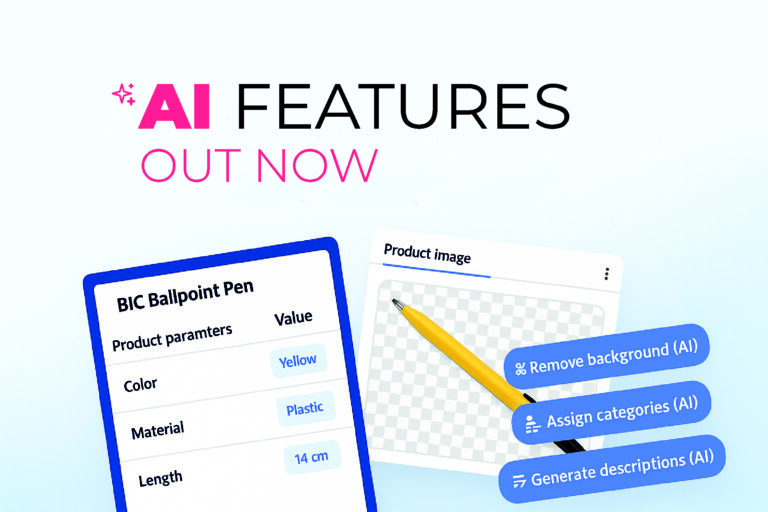

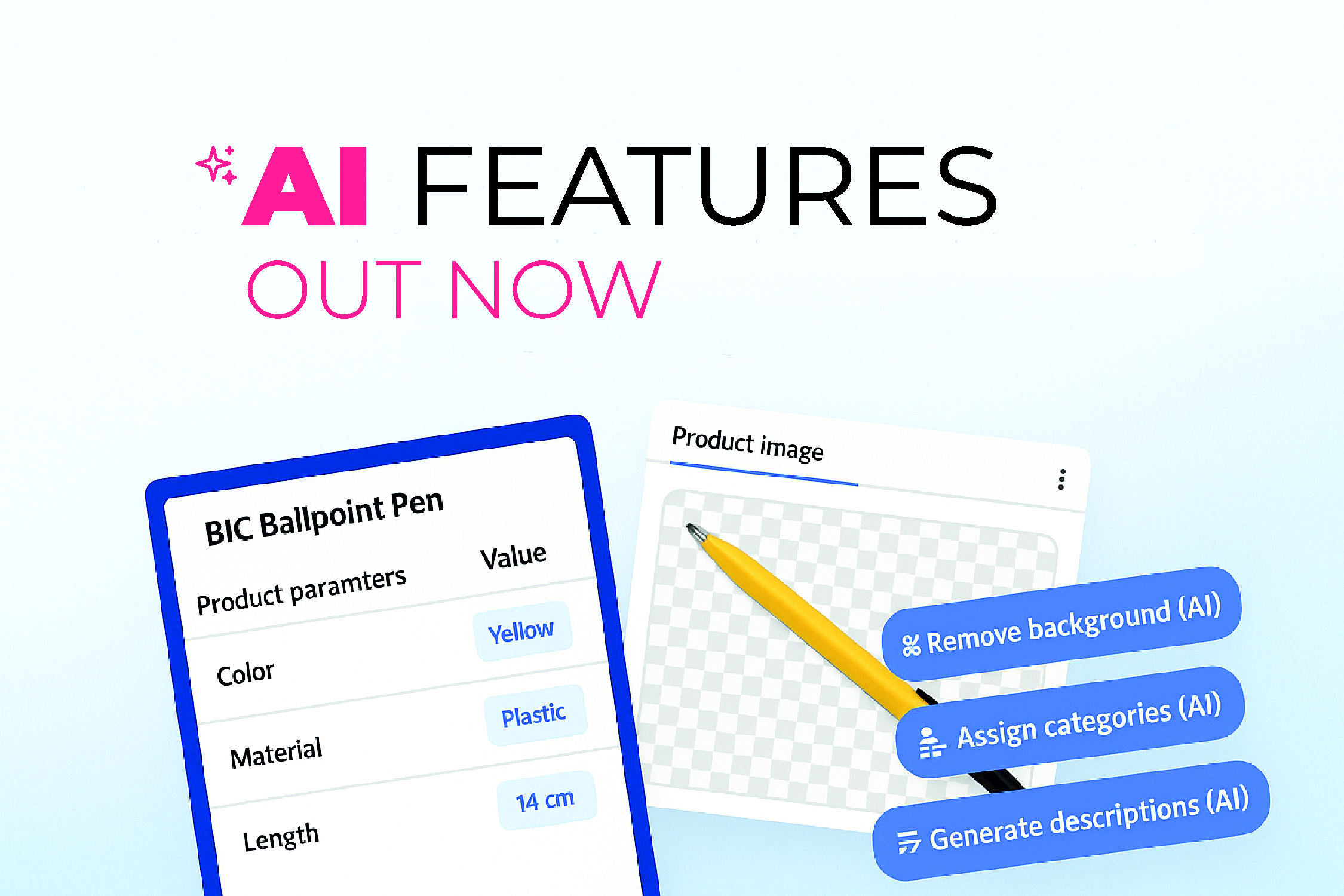
We’re excited to introduce a complete set of AI-powered features in PowerHub that help you list faster, clean up your catalog, and scale to new marketplaces without growing your team. Our AI engine combines models trained on large volumes of product data with state-of-the-art commercial models, so it can handle the repetitive work while you stay focused on strategy, margin, and growth.
Below you’ll find an overview of each AI feature and how you can use it in your daily work with PowerHub.
Automatic category matching on marketplaces
Choosing the correct category is one of the first and most important steps when you publish a product on a marketplace. Until now this often meant manual searching through long category trees or building complex mappings between your warehouse structure and each marketplace taxonomy.
With PowerHub, AI can now suggest the right category automatically. Based on your product data (name, description, parameters, brand, etc.), the model predicts the best-fitting category for each marketplace you sell on.
You can:
- apply category suggestions for a single listing directly in the listing form, or
- run category matching in bulk for a whole group of products prepared for listing.
This helps you speed up onboarding of new assortments and reduces the risk of products ending up in the wrong place, which can hurt both visibility and conversion.
AI-driven parameter completion
Every marketplace category comes with its own set of required and optional attributes: color, size, material, intended use, and many more. Filling them in manually for dozens or hundreds of products is tedious and error-prone.
PowerHub’s AI reads your existing product data and automatically completes many of these parameters for you. It analyzes names, descriptions, existing attributes, even free-text technical notes, and then fills in the relevant fields in the listing form.
For safety, strictly numeric or highly sensitive values like EAN, weight, or dimensions can remain under your manual control. You keep the final say, but AI does the heavy lifting.
You can launch parameter completion:
- with a single click for an individual listing, or
- as a bulk operation for all offers in a given batch.
Generating product names and descriptions
Writing good product copy takes time. It needs to be clear, persuasive, and aligned with the communication style of each marketplace and audience. Doing this for hundreds or thousands of SKUs is a real bottleneck for many teams.
The AI content generator in PowerHub turns your raw product data into high-quality names and descriptions in just a few seconds. For each product, the system uses everything it knows – parameters, images, specifications, existing short texts – and generates:
- a descriptive, search-friendly product title,
- a complete product description tailored to your guidelines.
You can adjust:
- tone of voice (neutral, sales-oriented, technical, etc.),
- length of the description,
- formatting preferences (paragraphs, bullet points, key highlights).
This gives you a consistent base that you can publish as is or treat as a solid draft to fine-tune.
Creating structured lists of key features
Customers love quick summaries. Marketplaces and your own store often need a short bullet list of key features under the main description. Creating those lists by hand is repetitive work.
PowerHub’s AI can automatically generate a list of key features for each product. It scans all available data and:
- extracts the most important attributes,
- rewrites them into short, benefit-oriented bullets,
- outputs them in a clean, structured list you can place wherever your template needs it.
You can ask AI to create a completely new list, or extend and refine an existing one. That way your listings stay both informative and easy to skim.
Generating special fields (e.g. bullet points for marketplaces)
Some marketplaces have their own special content requirements. A typical example is Amazon’s bullet points section, which highlights a handful of short, impactful statements near the top of the product page.
Instead of writing these manually, you can let PowerHub generate them automatically. The AI uses your descriptions and parameters to produce:
- marketplace-specific bullet points,
- in the correct language,
- focused on the benefits and differentiators that matter most in that channel.
You simply review the generated bullets and publish them straight from the listing form.
Bulk AI actions on products and offers
The true power of these AI tools appears when you use them in bulk. Nearly every feature described above can be launched as a batch operation, so you can:
- generate descriptions for hundreds of products in one go,
- match categories for an entire new catalog,
- fill in parameters automatically for a selected segment,
- apply background removal to all images in a chosen category.
On the product list you simply select the items you want to work with, choose the desired AI action from the bulk operations menu, and let PowerHub process them in the background. Tasks that would normally require days of manual work can be reduced to a few minutes of processing time.
Built-in limits and future development
Because AI features require a lot of computing power, there are daily limits associated with how many operations you can run. For typical sellers, the default limits will be more than enough for everyday work. If you rely heavily on bulk operations or manage very large catalogs, you can monitor usage in your account settings and request higher limits when needed.
We treat this first set of AI features as the foundation, not the final state. Our roadmap includes:
- support for additional marketplaces and content formats,
- smarter models for parameter and category prediction,
- more granular control over tone and structure of generated texts,
- deeper automation scenarios that combine multiple AI steps in a single workflow.
Start using AI in PowerHub today
If you already manage your products and listings with PowerHub, the new AI features are available right inside your familiar workflows. Look for AI buttons and bulk actions in the product list, product card, and listing forms on your marketplaces.
Let AI handle the repetitive parts of catalog management, while you focus on new products, pricing, campaigns, and building strong relationships with your customers.